
Purchase Cost Adjustments
A purchase cost adjustment corrects the cost of goods you have already received. Freight arrives on a separate invoice, customs comes in weeks later, a supplier credit changes the price - the stock is on your shelf at the wrong cost, and this document fixes it properly instead of by editing history.
Menu path: Purchases > Purchase Cost Adjustments
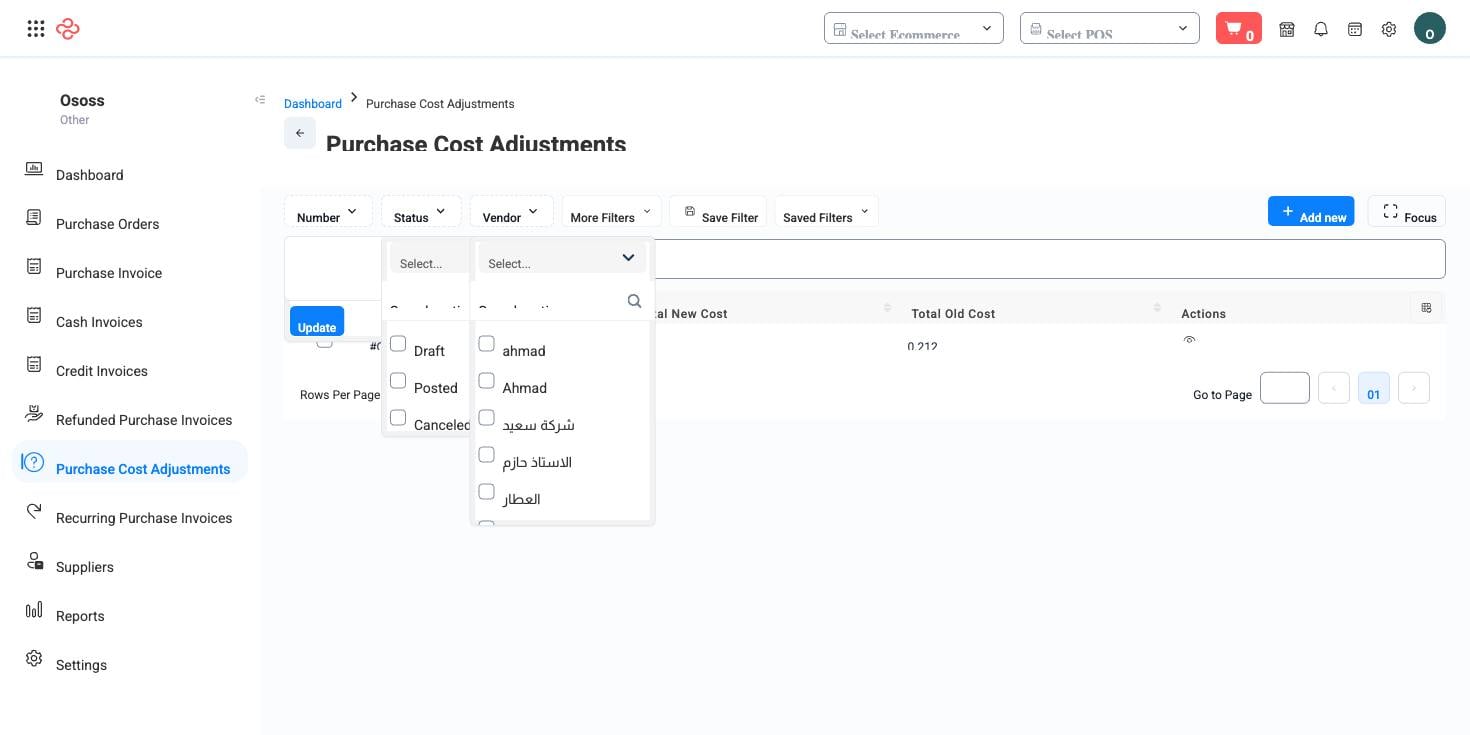
Why landed cost matters
Your margin is the gap between what you sold something for and what it truly cost you to have it on the shelf. If the invoice price was recorded and the freight was not, every margin figure on those goods is overstated - and the more you sell, the more confidently wrong the number becomes.
What the adjustment shows
The document is unusually transparent about its effect, which is what makes it safe to use:
| Column | Meaning |
|---|---|
| Old unit cost / New cost | Before and after, per unit |
| Old total cost / New total cost | Before and after, in total |
| Unit delta / Delta amount | The change itself |
| On hand quantity / On hand quantity applied | How much of the affected stock is still in stock, and how much of the change lands there |
| Sold quantity applied / Sold impact amount | How much was already sold, and the effect on that already-recognised cost of sales |
| Inventory impact amount | The change to your inventory valuation |
| Adjustment type, reason, reference note | Why this happened, in writing |
The split between on-hand and sold is the heart of it. Stock still on the shelf simply revalues. Stock already sold cannot be revalued in the past, so its share of the change hits cost of sales instead - and the document tells you exactly how much went each way.
Create a cost adjustment
- Create the adjustment against the Bill whose cost is changing.
- Choose the adjustment type and enter the new cost or the change amount per affected line.
- Read the impact columns before saving. The inventory impact and the sold impact are the two numbers your accountant will ask about.
- Write the reason and a reference note - the freight invoice number, the customs declaration, the supplier credit reference. An adjustment without a reference is impossible to defend at audit.
- Save. Valuation and cost of sales are updated according to the split shown.
Full reference
Every option and control on this page, at a glance.
Form fields (11)
Bill ID, Date, Invoice quantity, Item ID, Note, Number, Product, Quantity on hand, Total cost, Type, Unit cost
Standard list tools
Every list page in OSOSS shares these controls:
- Manage columns - the icon at the right edge of the header row: search columns, tick to show or hide, drag to reorder. Your selection persists for your user.
- Quick search - matches the page's primary field.
- Filter chips + More Filters - the chips are your defaults; More Filters exposes the full set below.
- Save Filter / Saved Filters - name a filter combination and recall it in one click; one can be your default view.
- Reset - clears filters back to defaults.
- Export All - downloads the current filtered rows with exactly the columns you have selected.
- Focus - hides the surrounding chrome for a full-width table.
- Row selection - the header checkbox selects the page or all matching rows, enabling bulk actions.
- Rows per page and page jumper - at the foot of the table.
- Custom fields - anything you define under Settings > Custom Fields appears here as both a column and a filter.
Related pages
- Purchase Invoices - the bill being adjusted
- Inventories - the valuation that changes
- Purchase Orders - the order behind the purchase
What you can do on this page
Every action on this page, step by step. What you see depends on your role, so a control your account is not set up for simply does not appear.
Add a record
- Click Add above the table - some pages label it New or show a + icon.
- Complete the form. Required fields carry a red asterisk and the form will not submit until they are filled.
- Click Save. Validation runs on submit; any field that fails shows its message directly beneath itself, and the form scrolls to the first problem.
- You land back on the list with the new record in place.
Fields on this form: Bill ID, Date, Invoice quantity, Item ID, Note, Number, Product, Quantity on hand, Total cost, Type, Unit cost
Edit a record
- Open the row's actions menu at the end of the row and choose Edit, or open the record and use Edit there.
- The form loads with current values. Change only what you need.
- Click Save.
Export the list
- Filter and choose your columns first - the export mirrors exactly what is on screen, not the whole table.
- Click Export All.
- The file downloads as a spreadsheet: one row per record, your visible columns in your order.