
Aged Receivables
Aged receivables shows who owes you money and for how long. Every customer balance is placed in an ageing bucket, so a total that looks acceptable is broken into the part that is current and the part that is becoming a bad debt.
Menu path: Accounting > Reports > Aged Receivables
URL: https://my.ososs.com/dashboard/reports/aged-receivables
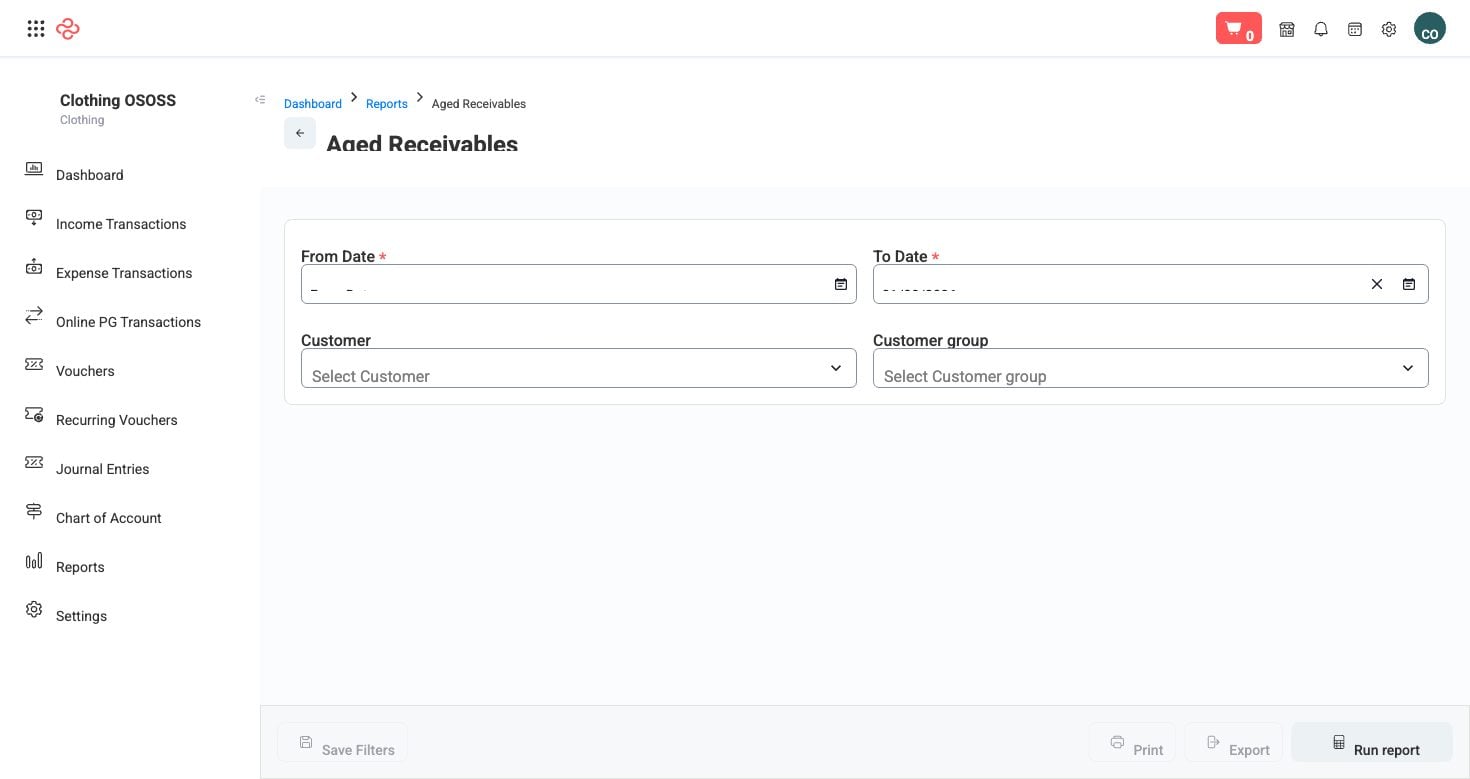
Screenshot from the live OSOSS Dashboard
What the output shows
The report runs as at a date you choose and lists customers across ageing columns:
| Column | What it means |
|---|---|
| Customers | The customer the balance belongs to |
| Invoices | Invoiced amounts making up the balance |
| Payments | What they have paid against it |
| Not yet overdue | Invoiced but still inside its payment terms |
| 30 or less | Overdue by up to 30 days |
| 31 to 60 | Overdue by one to two months |
| 61 to 90 | Overdue by two to three months |
| 91 or more | Overdue by more than three months |
| Total unpaid | The customer's outstanding balance |
| Account balance | The balance on their account |
The buckets are driven by each invoice's payment due date, which is why setting due dates correctly on invoices matters - an invoice with no realistic due date is either always current or always overdue, and neither tells you anything.
Reading it
- Read right to left. The oldest column is the one that decides your action: money in 91 or more rarely arrives without a conversation, and its likelihood falls with every month.
- Work by value inside each bucket. Ten small balances at 60 days matter less than one large balance at 45.
- Send customer statements to everyone in the 31-to-60 column before they reach 61. A statement at that point is a reminder; the same statement three months later is a dispute.
- Compare the shape month to month. Buckets shifting rightward mean your collection is slipping even if the total is flat.
Warning: Ageing is your earliest warning of a bad debt, and the only cheap moment to act is early. A balance that has crossed 90 days usually needs a decision - a payment plan, a hold on further credit, or a write-off - rather than another reminder.
Tip: Put a credit limit on the customers who live in the older buckets, or move them to prepayment. Continuing to sell on credit to a customer who is already 90 days late converts one problem into a larger one.
Related pages
- Customer Statements - the document you send to chase
- Customers Balance - balances without the ageing split
- Invoices - the due dates that drive the buckets